Bangor’s own, Dr David Carey, of the psychology department came to the Zoological society to answer whether humans are the only apes, or in fact animals, to have a hand preference.
Right-handedness is found in 90% of the western population. and of this 90% only 5% use their right hemisphere of the brain to speak; found using the “Wada” test. If you are ambidextrous then this increases to 15%.
Out of the “popular” primates, Gorillas and Chimps show ~60% right handedness and Orangutans show 50%.
Walruses (yes walruses) show 80% preference to their right hand, or flipper if you prefer.
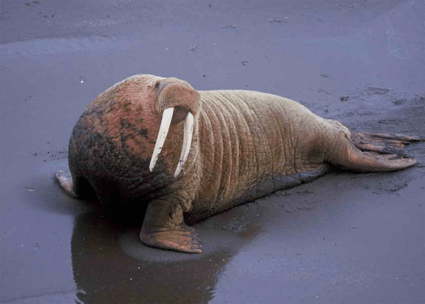
Are they really right flippered?
At this point the talk began to go from being interesting to informative. Dr Carey began to highlight issues that should be aware of when searching for references.
1. Be wary of frequency counts or averages, when you have no idea how many different individuals contributed to each estimate.
So, although I wanted to believe that walruses have a preference the evidence appears to be unreliable and so I am still left wondering.
The Sulphur-crested Cockatoo has shown a 96% preference to being left footed. Although this was only done on 20 birds and so lead to the next point:
2. Be wary of claims that are based on a relatively small number of animals.
Parrots also, allegedly, show a preference to their left foot with evidence of several papers being presented yet again something was afoot (right or left, whichever you prefer), the papers were all from the same academic group.
3. Be wary when all papers come from the same academic group.
This problem is common within this aspect of research on the brain. Studies comparing similarities between human and non primate brains often come from one or two research groups.
One paper actually showed a 58% preference to right handedness with a large sample size (467). Yet as always statistics never lie (unless done wring) and the odd distribution for results on the funnel plots raised doubts on the strength of the evidence.
4. Be wary when several factors are being tested: Gender, captive or not? etc.
Another issue when recording purely physiological behavioural responses is that sometimes it is hard to determine the actual preference. For example, when given a tube with food at the bottom, is the dominant hand the one holding the tube or the hand putting the hand in the tube?
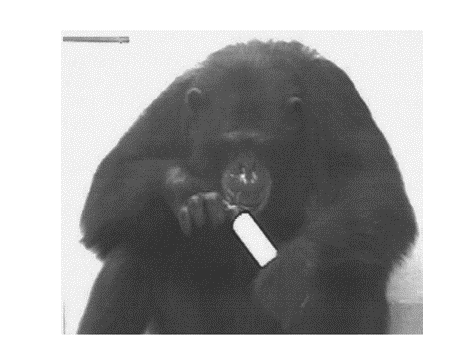
A chimp partaking in an experiment. Which hand is the dominant hand?
When testing humans it is possible to communicate with them and so handedness is usually asked about.
I found this talk highly interesting and informative. Dr. David Carey was very good at retaining attention of the audience though participation or the odd anecdote. Although unlikely that I will look further into this field of study, it did give me an insight into the more unique areas of research within zoology.
The tips when looking for scientific papers were also very helpful and I am sure I will use these not only this year but for the rest of my academic career.
Although research in behaviour does interest me, I cannot see myself involved in a career that involves it. This is due to the inconsistencies in results that individuals have, but also due to the inconsistencies that experimental design may have between researchers.
 Ryan Buttery: A Zoological Blog.