Alexander Georgiev came to the Zoological society to give a talk on the Red Colombus project.
However I took particular interest to the first part of the talk where he discussed the implications on how behaviour studies aid with conservation.
Overall there a many more behavioural studies that focus on the threats of conservation than there are for solutions to these threats.
It has been stated that research has had a ‘negligible impact on conservation’.
This however is very useful statement, as it has allowed behavioural researchers to get their studies to focus on the wider implications relating to conservation.
He then moved on to talk about the current issues within the world at the minute and how this is affecting Primates.
Aspects of Primates ecology that are at risk vary wildly:
- Diet
- Life History
- Geographic range
- Social Groups
Climate change and its affects on the feeding behaviour of folivores was looked at first.
In regards to climate change, those primates who are folivores are most at risk.
‘Folivores are most at risk’
An increase in global temperature will lead to more evaporation and hence more rainfall.
This in turn can affect the quality of food making it harder to digest and reducing nutritional value from food items.
On the opposite side to this however, a decrease in rainfall and higher temperatures lead to more fibre being found in their food.
Older females of a population can not cope with this increase and therefore reduces the amount of milk produced, which can lead to an increase in infant mortality.
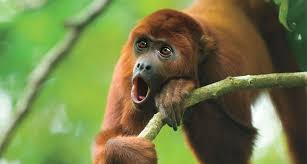
A Howler Monkey; one of the numerous folivorous species we could potentially lose to Climate Change.
‘We are therefore at risk of losing them from our world’
Another global conservation threat is deforestation.
This is where humans remove rain forest in order to use the wood and most commonly palm oil for their own usage.
Those species of Primates that have small geographic range are at risk of losing their habitats and we are therefore at risk of losing them from our world.
For those Primates who have large geographic range but are social, can also be affected by deforestation.
Not to the point where the species is lost, but in removing parts of their habitat, territories of social groups can be lost.
This may cause complete loss of social groups and cause individuals to join adjacent groupings, affecting the hierarchies within these groups.
Overall this talk was very informative and covered a wide scope of topics, but it was the implications that behavioural studies can have on conservation that I took most interest in as I had never considered there would be any cross-over between these topics. It gave me a wider view on the different areas of research that are involved in conservation and interested me greatly, despite being on Primates which is a field I am unlikely to go into. I may however enter the field of conservation due the wide variety of research areas that are involved in it.
 Ryan Buttery: A Zoological Blog.