On the 11th October, Bangor’s own PhD researcher Dylan Ellen came to the entomology society and talked about his work on the Welsh honey bee.
Dylan’s work has three aims:
- To establish the abundance of the Welsh dark bee
- To explore Varroa mite resistance in the bees of North Wales
- To investigate isolated mating of bees in Wales
Dylan conducts his work on all 7 species of bee in Wales.
These are: pis mellifera, Apis cerana, Apis dorsata, Apis florea, Apis andreniformis, Apis nigrocincta and Apis koschevnikovi.
With the bee populations declining naturally or accidentally, research into the future of the bee populations is extremely important
Dark bee abundance
Dylan samples different sites across Wales in order to produce an accurate measure of the abundance of Welsh dark bees.
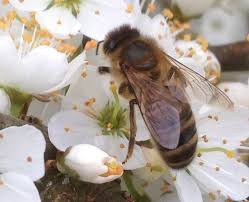
The Welsh dark honey bee
The bees are then identified using mitochondrial DNA and nuclear DNA.
This data not only allows species identification but also allows Dylan to see the descendance of the bee and their evolutionary diversity.
The Welsh bee population is built from native bees and imported ones from Italy and Slovenia.
Nuclear DNA also lets Dylan see if there has been any introgression between the native individuals and the imported ones.
Varroa resistance
The Varroa parasite is a large threat to honey bees due to its negative impact on the mating of bees as well as honey production.
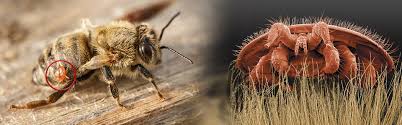
The killer parasite Varroa. Left: Varroa on a honey bee, Right: Close up Varroa
It id thought that the Welsh dark bee is actually resistant to this parasite, however this has never been proven.
Dylan is investigating this resistance.
He checks different colonies of the dark honey bee for infestation from the parasite and grooming behaviours.
Low levels of infestation implies a resistance where as the increased grooming behaviour implies that parasites are being removed and therefore cannot spread.
If proven that these bees have a resistance the trait could be bred to other species to help protect their population numbers.
Isolated mating in Wales
Dylan uses GIS mapping to find methods of isolating honey bee reproduction.
The purpose of keeping reproduction isolated is to stop the introgression of unfavourable traits.
Suitable locations are found by combining data of relief, forage resources and genetics.
Overall Dylan’s talk was incredibly informative as I had not realised that there were so many different honey bees in Wales or that they may even have a resistance to a parasite which causes the decline of many other species. Dylan’s work is therefore extremely important for the future due to the positive impact it could potentially have on the current honey bee populations.
Although recently the idea of conservation has interested me greatly I do not think that the conservation of invertebrates is what I would like to do. When considering conservation I think I would like to work with larger animals, possibly an umbrella species as it means my efforts to conserve one species will help many others that resources are not available for.
 Ryan Buttery: A Zoological Blog.